Model Context Protocol: Universal AI Integration Standard
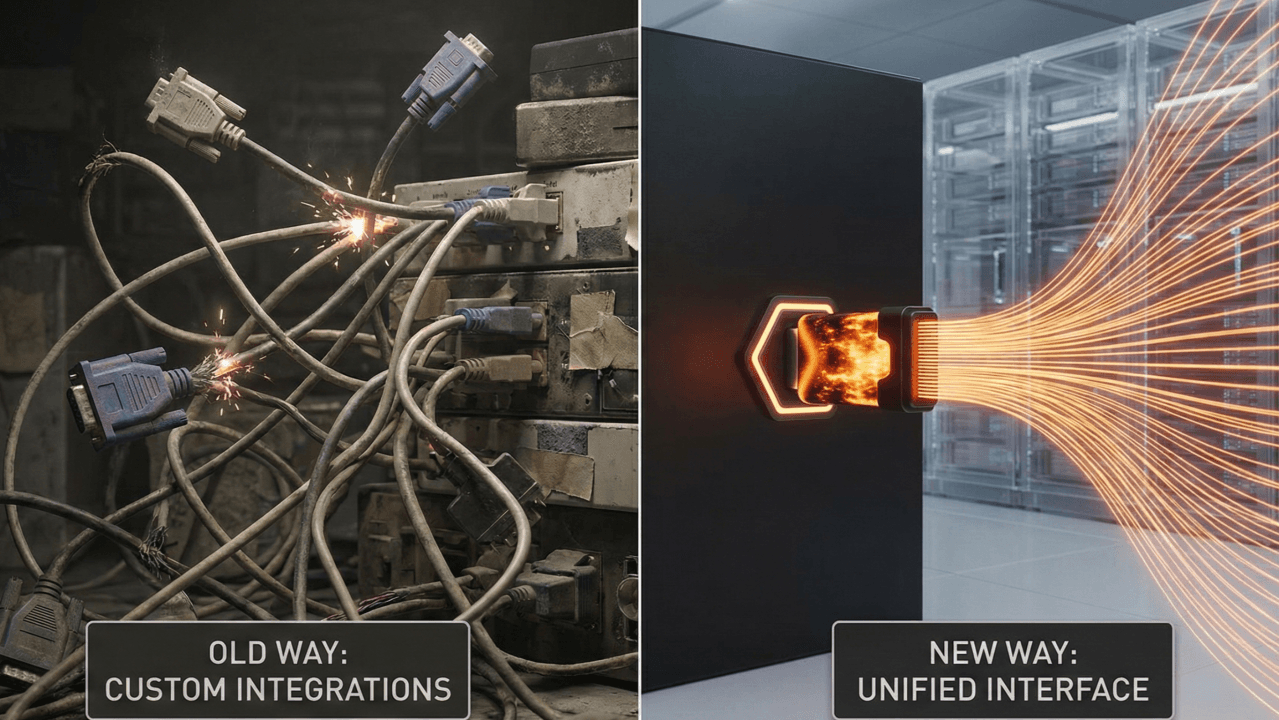
MCP: The Universal Port for AI Tools - and Why On-Device Servers Win on Privacy
The Model Context Protocol is rapidly becoming the standard for how AI assistants connect to tools and data, solving the N×M integration challenge that has forced development teams to rebuild connectors for every model-vendor combination. Since Anthropic launched MCP in November 2024, thousands of servers have been deployed, major IDEs have integrated support, and the protocol has emerged as the de facto standard for AI tool integration in the agentic era.
The Integration Problem MCP Solves
Before Model Context Protocol AI, each AI assistant required custom integrations for every external system—GitHub repositories, Slack workspaces, databases, terminal environments, and browsers. With N assistants and M data sources, platform teams faced N×M bespoke connections, duplicated engineering effort, and vendor lock-in that made switching models prohibitively expensive.
MCP collapses this complexity to N+M: build one MCP server per data source and one MCP client per assistant, and they all interoperate through a standardized JSON-RPC 2.0 for AI protocol. The analogy to USB-C proves apt—one universal AI integration protocol that works with any peripheral, letting teams swap devices without rewiring infrastructure.
How MCP Client Server Architecture Works
MCP uses a three-component architecture that separates concerns and enables cross-model interoperability:
Host Applications AI assistants like Claude Desktop MCP, MCP in VS Code, MCP in Cursor, and ChatGPT Developer Mode run MCP clients that translate user intent into protocol messages.
MCP Clients These components handle the protocol handshake, discover available tools through schema-driven definitions, and invoke capabilities any compliant LLM can understand.
MCP Servers Your systems—repositories, terminals, databases, APIs—expose functionality through standardized interfaces that eliminate brittle point-to-point code. New services onboard through registration alone, without custom integration work.
Explosive Ecosystem Momentum
MCP adoption 2025 has accelerated beyond initial projections. Support now spans Anthropic with reference implementations, OpenAI Agents SDK MCP integration announced in March 2025, and Microsoft's public endorsement of the MCP standard. Major developer tools including Cursor and Windsurf have integrated native support.
Enterprise SaaS platforms offer official MCP servers for business workflows: Asana for task management, Notion for knowledge bases, Glean for search, and Miro for collaboration. The MCP developer community has built thousands of servers connecting GitHub, Linear, Slack, Gmail, Postgres, headless browsers, and over 500 business applications via platforms like Composio.
This network effect—more hosts driving more servers, which attract additional hosts—mirrors the standardization curve that made USB-C ubiquitous.
Enterprise Value Through Standardization
Enterprise AI standardization via MCP delivers concrete benefits that justify platform investment:
Reduced Complexity Platform teams publish a catalog of safe, policy-governed capabilities—create Jira issues, query BigQuery, run terminal commands—that any compliant LLM can use without custom code. This AI integration framework eliminates per-model integration overhead.
Enterprise AI Governance Centralize MCP authentication and authorization at the server boundary using OAuth for MCP and OIDC for AI implementations. RBAC for AI agents enforces least-privilege AI access through role-based permissions rather than simplistic token-based controls. Every tool call flows through a single, observable layer with AI tool policy catalogs defining permitted actions.
Cross-Platform Portability Switch from Claude to ChatGPT or add a new IDE without rewriting integrations—MCP servers remain unchanged. This AI system interoperability prevents vendor lock-in.
Scalable AI Orchestration Deploy containerized MCP servers as microservices behind load balancers, with namespaces enabling multi-tenant MCP deployments and elastic scaling across regions.
Code Execution Unlocks Dramatic Efficiency
As AI agent connectivity expands, loading hundreds of schema-driven tool definitions into context windows becomes prohibitively expensive. AI code execution efficiency addresses this by presenting servers as code APIs on a filesystem—agents load only needed tools on demand, filter data in the execution environment, and compose multi-step workflows without bloating context.
Token Reduction with MCP proves dramatic. Fetching and filtering a 10,000-row spreadsheet traditionally sends all rows through the model; with code execution, the agent filters locally and returns only five pending orders—cutting token use by 98.7% while preserving privacy since sensitive data never enters the model's context. Real-world implementations report 60-95% token savings on routine tasks.
SyntX: Privacy-First MCP Implementation
At SyntX, we've built the local-first AI development platform optimized for developers who need GitHub, terminal, file, and browser context without cloud exposure.
On-Device AI Context SyntX MCP client runs local MCP servers entirely on-device, feeding local repositories, test results, and lint rules into coding workflows with zero data egress AI. Your proprietary code, internal APIs, and compliance patterns never leave your infrastructure.
MCP-Gated Permissions Secure AI coding agents request explicit user confirmation before executing terminal commands or opening pull requests, keeping developers in control. This AI governance frameworks approach balances autonomy with oversight.
Local Code Execution MCP SyntX privacy-first AI implements code execution patterns that filter and transform data locally—secrets, internal APIs, and proprietary logic stay in the IDE. Offline AI assistants work without internet connectivity, eliminating cloud latency and variability.
Reproducible AI Workflows Local MCP servers produce consistent results independent of external service availability, enabling AI privacy and compliance requirements in regulated industries.
Practical Enterprise Rollout Strategy
MCP rollout strategy should prioritize safety and measurable impact:
Start Narrow Pick one high-value, low-risk flow—read local Git history, run tests, search documentation—and building MCP servers with least-privilege credentials. Add Guardrails Implement schema validation, argument allow-lists, output checks, and audit logs that map every tool to named policies. Pilot Internally Wire MCP for enterprise automation into Cursor or VS Code for a small team, track PR cycle time metrics and AI defect rate reduction, and iterate before scaling. Harden for Production Introduce mutual TLS, per-tool scopes, encryption for regulated data, and secure AI orchestration layers for multi-tenant deployments.
The Path Forward for AI Integration
With multi-vendor support, a thriving ecosystem of thousands of servers, and emerging enterprise-grade AI patterns for security and governance, MCP is becoming the universal AI protocol for agentic systems. For coding assistants specifically, local MCP servers offer the context richness of cloud tools with the privacy and control of on-device fine-tuning workflows—positioning privacy-first platforms to capture developer trust in the agentic era.
Ready to deploy private AI agent frameworks with full repository context? Explore how SyntX implements SyntX privacy-first AI through local MCP servers that keep your code secure while delivering the connectivity modern AI assistants require.