Breaking the GenAI Paradox: How Autonomous AI Agents Drive Measurable Enterprise Impact
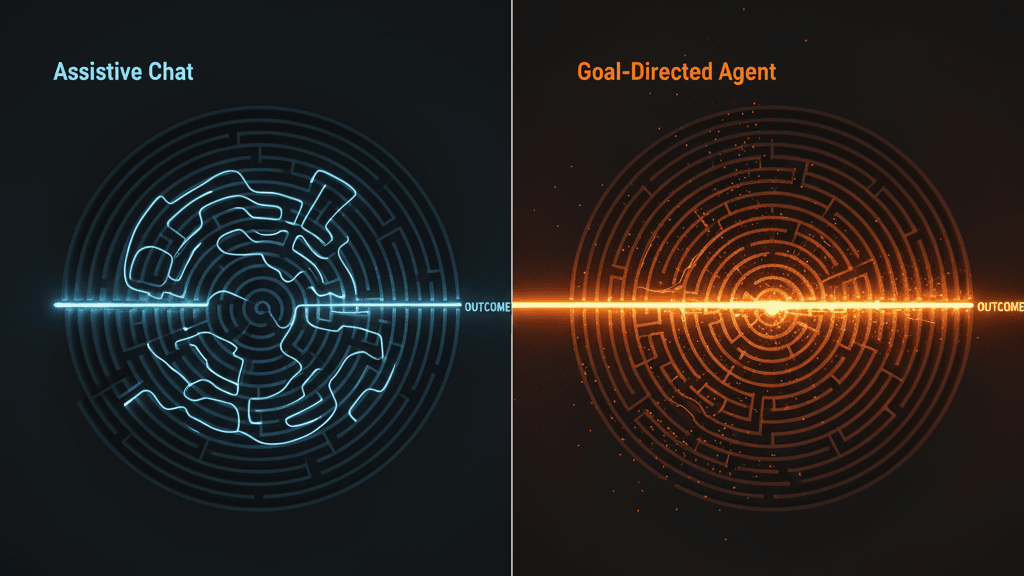
Agentic AI in enterprises represents a fundamental shift from assistive chat interfaces to goal-directed AI systems that plan, execute, and coordinate across business workflows. Industry analysts forecast that by 2028, a significant share of enterprise applications will incorporate autonomous AI agents, marking the maturation from experimental copilots to outcome-oriented AI agents embedded in core decision flows.
The Trajectory of Enterprise AI Agent Adoption
Enterprise AI adoption trends 2028 point to rapid integration of agentic capabilities in business workflows. Strategy research indicates the next 2-3 years will see enterprise AI agents move from isolated pilots to production systems that handle routine decisions, orchestrate multi-step processes, and coordinate across enterprise software ecosystems.
This AI workforce transformation differs fundamentally from current copilot implementations. Rather than suggesting actions for humans to execute, planning and acting AI agents take ownership of entire workflows—analyzing context, developing execution plans, and delivering completed outcomes within governance guardrails.
Why Many GenAI Pilots Stalled
Despite significant investment, many organizations struggle to demonstrate measurable P&L impact from generative AI initiatives. This "GenAI paradox" stems from focusing on assistive capabilities that augment existing workflows rather than autonomous agents that fundamentally reshape them.
AI copilots vs autonomous agents represents more than semantic distinction. Copilots require constant human supervision and approval, limiting throughput to human capacity. Autonomous agents, properly constrained, operate independently—completing tasks while humans focus on higher-value strategic work.
The breakthrough comes from outcome-oriented AI agents designed around measurable business metrics rather than interaction quality. When agents own results—not just suggestions—teams can track real measurable ROI from agentic AI.
SyntX's Approach: On-Device Agents with Measurable Impact
At SyntX, we've built privacy-first AI automation that demonstrates how enterprise agentic AI workforce capabilities deliver concrete value today—not in distant futures.
SyntX on-device AI agents start where agents prove safest and most valuable: autonomous coding workflows. Our system enables AI planning and execution in coding through several key capabilities:
MCP-Gated Permissions Rather than unrestricted system access, MCP-gated AI permissions give agents precisely scoped capabilities. An agent might access git repositories, run test suites, and create pull requests—but cannot modify production systems or access unrelated resources. This enterprise AI governance model ensures secure enterprise AI deployment without sacrificing autonomy.
Full-Cycle Workflow Ownership SyntX agents don't just suggest code changes—they plan implementations, write tests, verify correctness, and autonomous pull requests with AI ready for human review. This AI-driven test automation completes entire development cycles, demonstrating true agentic AI capabilities.
Measurable Business Metrics We measure enterprise AI productivity through concrete outcomes:
- PR cycle time reduction with AI tracks how quickly changes move from concept to review
- Defect escape rate metrics quantify code quality improvements
- Test stability through AI agents measures reliability gains
These measurable business impact indicators separate real value from hype, proving that agentic AI for software quality improvement delivers tangible results.
Building the Enterprise Agentic Architecture
Successful next-gen enterprise AI architecture requires infrastructure supporting agent-based enterprise automation at scale. This means scalable AI orchestration that coordinates multiple specialized agents, AI coordination across enterprise systems with proper governance, and embedded AI agents in decision flows that integrate naturally into existing processes.
The transition to hybrid human-AI teams demands rethinking workflows around agent capabilities. Rather than humans executing tasks with AI assistance, agents own routine workflows while humans focus on strategic AI adoption roadmap decisions, complex judgment calls, and creative problem-solving.
Privacy and Scale in the Agentic Era
Privacy-first AI automation becomes critical as agents gain autonomy. SyntX's on-device approach ensures secure enterprise AI deployment where agents process sensitive data locally, update models privately, and operate within organizational boundaries—never exporting proprietary information to external services.
This enterprise-grade AI reliability enables teams to deploy autonomous AI agents confidently, knowing governance constraints remain enforced even as agent capabilities expand.
Ready to implement agentic AI that delivers measurable outcomes? Explore how SyntX brings autonomous coding agents to your enterprise with AI workforce analytics that prove ROI.